Women’s health remains one of the most underfunded and under-explored areas in health research, despite its profound importance to the lives of women and health outcomes across populations. Today, only about 5 percent of health research and development (R&D) funding worldwide is dedicated to women’s health, and less than one percent of that share supports non-cancer-related conditions, leaving vast gaps in our understanding of conditions that disproportionately or uniquely affect women. These gaps persist globally, including within the United States, where the National Institutes of Health (NIH) plays a central role in shaping biomedical research priorities.
While these disparities remain clear today, meaningful progress has been made in women’s health—particularly in expanding women’s inclusion in research and establishing foundational policies that prioritize sex and gender in science. This March, in recognition of Women’s History Month, we look back at key milestones at NIH that have advanced women’s health research. These achievements not only highlight how far the field has come but also help guide where we need to go next.
 | For decades, women were systematically excluded from clinical research, leading to critical gaps in the knowledge needed to adequately understand, diagnose, and treat diseases and other health challenges faced by women. Women’s symptoms were misunderstood, their risks underestimated, and their health needs too often treated as a secondary, niche issue rather than a scientific imperative. The women’s rights movement of the 1960s ignited a parallel women’s health movement that forced policymakers and scientists to confront systemic disparities. A pivotal turning point came in 1983, when the Public Health Service Task Force on Women’s Health Issues—established by Assistant Secretary for Health Edward Brandt Jr.—became the first federal initiative focused on increasing women’s inclusion in NIH-funded clinical trials. The Congressional Caucus for Women’s Issues echoed that call to action. These were not symbolic gestures, but structural interventions that began reshaping the research enterprise.
|
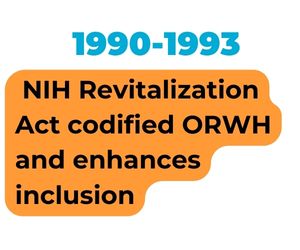 | By 1990, sustained advocacy led to a major advancement: the creation of the NIH Office of Research on Women’s Health (ORWH). For the first time, NIH had a dedicated mechanism and leadership to strengthen, coordinate, and champion women’s health research across the agency. Congress codified and strengthened this progress with the 1993 NIH Revitalization Act, which formally established the ORWH into law and, importantly, mandated that women and minorities be included in all NIH-funded clinical research. The latter change was spurred by a group of female members of Congress who recognized deficiencies in NIH’s prior 1986 internal guidelines that urged but did not require that women be included. These landmark policy changes helped transform women’s health from a peripheral cause into a core component of biomedical science, propelling meaningful scientific progress.
|
 | With the ORWH fully in force, NIH launched additional efforts to improve women’s health research, including the Specialized Centers of Research on Sex Differences. This initiative aimed to accelerate the translation of discoveries about sex differences from basic science into clinical applications, bridging gaps between laboratory research and women’s clinical care. In 2018, the effort evolved into the Specialized Centers of Research Excellence on Sex Difference—a network of research centers dedicated to advancing translational research on the role of sex differences in the health of women.
|
 | The 2006 NIH Reform Act, further strengthened ORWH by elevating it into the NIH Office of the Director. This shift gave ORWH greater authority to coordinate across institutes and centers, influence research priorities, and ensure women’s health considerations were integrated at the highest levels of decision-making and across the entire R&D continuum.
|
 | After two decades of building a scientific and policy foundation for better inclusion, NIH took another pivotal step that reshaped the research enterprise: the NIH Policy on Sex as a Biological Variable (SABV). Implemented in 2016, the policy required researchers to factor sex into the design, analysis, and reporting of basic, preclinical, and clinical studies.
For years, basic science relied heavily on male cells and male animal models, embedding blind spots at the earliest stages of discovery. By requiring scientists to examine how sex influences health and disease from the outset, NIH strengthened the rigor, reproducibility, and translational value of federally funded research. The policy helps ensure that differences in disease progression, drug metabolism, immune response, and treatment efficacy are identified early before they become costly failures or missed opportunities in product development.
By institutionalizing sex-informed research design, SABV signaled a clear shift in practice. Inclusion is not just about who participates in research, but also about how science is conducted.
In parallel, Congress also passed the 2016 21st Century Cure Act that affirmed and enhanced compliance requirements around SABV and required that people of all ages be included in clinical research unless valid scientific reasons existed for exclusion. The policy also established a task force to advance recommendations, knowledge, and guidance around the safe inclusion of pregnant and lactating individuals in clinical trials.
In 2019, NIH published its first comprehensive strategy to advance the health of women, which outlined the agency’s activities and objectives from 2019 through 2023. Though an updated strategy has since been released, this first plan marked an important first step in translating ORWH’s mission into a unified NIH vision with a structured path forward.
|
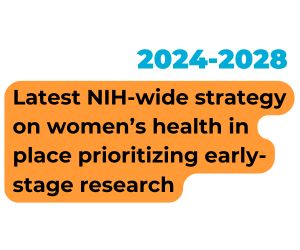 | With input from technical experts and civil society, NIH published its second women’s health strategy. The current plan prioritizes advancing research on women’s health disparities and underscores the importance of basic and translational research in biomedical discovery and innovation. While it addresses other issues, including actions related to the inclusion of women and girls in clinical trials, much of its focus is on early-stage research. As the strategy concludes in 2028, there is an opportunity to build on this foundation by strengthening support for later-stage R&D and addressing priority gaps in health innovations for women.
|
 | As we mark International Women’s Day, the question is no longer whether women should be included in research, but whether research is delivering the health products that women need. NIH has built the policy architecture to enhance representation, inclusion, coordination, and strategic priority-setting across the research continuum, correcting historical blind spots and reshaping the research enterprise.
Yet inclusion alone does not guarantee innovation. As we look ahead to the future of women’s health research at NIH, continued collaboration will be essential. We encourage NIH to sustain and deepen its engagement with academia, researchers, industry, and civil society as it shapes the next iteration of its women’s health strategy. Building on this dialogue will help ensure priorities reflect both scientific opportunity and real-world need.
GHTC stands ready to partner in shaping what comes next. NIH has made meaningful progress over the past several decades—now is the moment to build on that momentum and work together to drive even greater impact on women’s health in the years ahead. Beyond this strategy, GHTC wants to continue working with Congress to ensure that the progress made at NIH through various avenues is codified into law. By advancing strong, bipartisan policies that strengthen and sustain women’s health research, Congress can protect recent gains and help ensure they deliver lasting impact for patients and communities around the world.
As the agency sets its course, we urge decision makers to maintain a strong commitment to women’s health research, including research that advances the development of new priority health technologies for women. The current strategy’s emphasis on foundational and basic science lays critical groundwork for breakthrough products, but translational and later-stage research are equally vital to move promising discoveries across the finish line and into the hands of patients.
This month, and every month, offers an opportunity to reflect on the progress made, the gaps that remain, and the shared responsibility to accelerate a future where investing in and supporting women’s health research is not the exception, but the standard. |